
What if the best wedding photography timeline is the one that lets you forget about the clock? Creating a wedding day photography timeline can feel like fitting getting-ready photographs, portraits, travel, and changing light into an already full day. It’s natural to wonder how much time each part needs and whether stepping away for photographs will take you from the people you came to celebrate with.
A thoughtful schedule doesn’t ask your wedding to perform for the camera. It gives meaningful moments room to unfold, with enough structure to guide the day and enough breathing room to keep it feeling like yours. Your photographer can help fit coverage around your priorities, so the photographs complement the celebration rather than dictate it.
In this guide, you’ll learn how to estimate time for getting ready and portraits, weigh a first look against an aisle reveal, and coordinate the ceremony, reception, travel, and sunset with your photographer and planner. You’ll also find practical ways to build flexibility into the schedule, so a small delay doesn’t turn a joyful day into a race. The goal is a clear plan that still leaves space to be present.
Key Takeaways
- Start with the photographs and private moments that matter most to you, then let those priorities shape the day’s pace.
- Build the schedule around ceremony time, sunset, venue access, travel, and your preferred approach to portraits.
- Compare a first look with an aisle reveal by considering privacy, guest time, available light, and what feels emotionally right for you.
- Creating a wedding day photography timeline is easier when you fix key event times first, map locations, and add realistic transitions and buffers.
- Share one current schedule with your wedding team and appoint a decision-maker to communicate any day-of changes.
Start Your Wedding Day Photography Timeline with the Moments That Matter
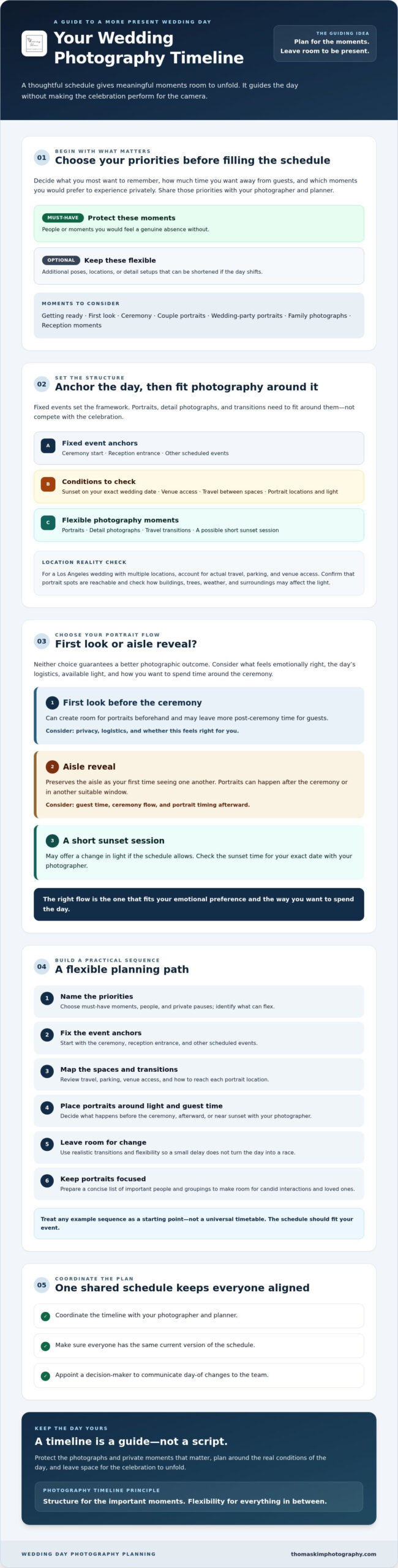
A wedding photography timeline should guide the day, not script every interaction. Before creating a wedding day photography timeline, decide what you most want to remember, how much time you want to spend away from guests, and which moments you’d prefer to experience privately. These answers give your photographer and planner a useful starting point for shaping coverage around your priorities instead of forcing the celebration into a rigid sequence.
Separate fixed events from flexible photography. The ceremony start, reception entrance, and other scheduled events anchor the day. Portraits, detail photographs, and travel between locations need to fit around them. For a Los Angeles wedding with multiple locations, plan for actual travel, parking, and venue access rather than assuming that each transition will be immediate.
Which wedding moments deserve protected photography time?
Consider getting ready, a first look, the ceremony, couple and wedding-party portraits, family photographs, and reception moments. Then separate essential images from optional setups. A concise list of important people and groupings helps keep portraits focused, leaving more room for candid interactions and time with loved ones. If preparation photographs matter to you, explore luxury wedding getting-ready photography as you decide what you want captured.
- Must-have: moments or people you would feel a genuine absence without.
- Optional: additional poses, locations, or detail setups that can be shortened if the day shifts.
Wedding photography can draw on different approaches, from candid storytelling to more traditional portraits. A brief overview of Wedding photography can help you describe the balance of styles you’re drawn to when planning coverage.
How do your priorities shape the day’s rhythm?
A first look can make room for portraits before the ceremony. Waiting until afterward preserves the aisle reveal as your first time seeing one another. Neither choice guarantees a better photographic outcome. The right fit depends on your emotional preference, the day’s logistics, and how you want to spend the hours around the ceremony.
A private pause after the ceremony may mean fewer portraits during cocktail hour. A receiving line or a desire for more time with guests can also affect when photographs happen. A photography timeline is a flexible sequence of protected coverage moments, shaped around the celebration rather than imposed on it.
Share your priorities with your photographer and planner so they can coordinate the schedule. Once decisions are settled, make sure everyone has the same current version. One clear reference helps prevent conflicting plans from pulling attention away from the day.
Build the Wedding Photography Schedule Around Light, Coverage, and Transitions
The ceremony time is only one anchor. Sunset, venue access, the distance between preparation and ceremony spaces, and your portrait plans all affect where photography fits. When creating a wedding day photography timeline, check the sunset time for your exact wedding date rather than relying on a seasonal estimate. Then ask your photographer which portraits make sense before the ceremony, afterward, or in a short window near sunset.
Natural light changes with the date, weather, location, and surroundings. A portrait spot that seems open may be shaded by buildings or trees at the time you arrive. Confirm locations and access with the venue and photographer in advance. Check whether you can reach each chosen spot without leaving the property or disrupting another part of the event.
How should you schedule portraits around ceremony and sunset?
Pre-ceremony portraits can leave more post-ceremony time for guests. Portraits after the ceremony may suit couples who want to preserve the aisle reveal. A first look creates another opportunity for portraits beforehand, while a short sunset session can offer a change in light if the schedule allows. These are options, not rules. The Knot’s wedding photography timeline guide offers examples to help you think through how coverage can fit around your event sequence.
Use an illustrative sequence, not a universal timetable. For example, you might set aside an adaptable portrait window before the ceremony, protect time for family photographs afterward, and step away briefly near sunset. The right windows depend on your coverage, locations, and event plans. Review them with your photographer instead of treating sample durations as fixed requirements.
Where should you add transition and travel buffers?
Leave space between activities for the movements that rarely appear in a neat schedule: walking from the preparation room to the ceremony, gathering family members, adjusting clothing, and moving between venues. For Los Angeles travel, check traffic and parking conditions for your specific date and route, and ask the venue about arrival, access, and parking guidance. Underestimating these transitions can turn a portrait session into a rushed one.
A thoughtful buffer protects both the photographs and your experience, giving people time to arrive, settle, and be present. If photography and videography teams are both involved, coordinate their locations and transitions so they can cover the same moments without crowding one another.
Review the route, access details, and portrait windows with your photographer and planner, then include them in the shared schedule. If you’re exploring wedding photography, consider how your coverage can be planned around the day’s light and movement.
Compare First-Look and Traditional Timelines Before Choosing Your Flow
The choice between a first look and an aisle reveal shapes more than one emotional moment. It affects when portraits happen, how much time remains with guests, and which light is available. Neither approach guarantees a better photograph. Choose the sequence that feels meaningful to you and fits your venue, coverage, and plans for the day.
As you compare options, consider privacy, portrait timing, family availability, and how you want the hours around the ceremony to feel. The Wedding Photography Timeline Guide offers examples of how different sequences can be arranged, but your schedule should reflect your own priorities.
| Approach | Possible advantages | Trade-offs and coordination |
|---|---|---|
| First look | Creates a private moment before the ceremony and an opportunity to take some couple portraits earlier. | Requires both partners to be ready and available beforehand; consider whether you want to see each other before the aisle reveal. |
| Traditional reveal | Preserves the ceremony as the first time you see one another. | Portraits follow the ceremony, so coordinate family availability, reception transitions, and remaining daylight. |
What changes when you plan a first look?
With a first look, you can schedule some couple portraits before the ceremony if that suits you. Wedding-party or family photographs may also fit earlier when those participants are ready and available. This can create a quieter portrait window and may leave more flexibility afterward, depending on your plans. Decide together whether that private pause feels right, then confirm the sequence with your photographer and planner.
What changes when you wait until after the ceremony?
Keeping the reveal for the aisle means couple portraits happen afterward, often alongside family and wedding-party photographs. Check that key relatives can stay available, and account for the transition into the reception so portraits don’t unintentionally take time away from guests. If the ceremony ends close to sunset, discuss which portraits matter most and whether a brief session later in the day makes sense.
Your wedding photography coverage can be shaped around either approach. The schedule should support the story you want preserved, not dictate how you experience it.
Photographs don’t need to interrupt the celebration repeatedly. Group family combinations and wedding-party portraits into planned windows, prepare a concise list of names and groupings, and let the photographer guide the sequence. That structure reduces interruptions while leaving space for candid moments and time with guests.
Create a Practical Wedding Day Photography Timeline Step by Step
Turn your priorities into a working plan in a deliberate order. Creating a wedding day photography timeline is easier when confirmed event times anchor the schedule and flexible photography windows fit around them.
- 1. Fix the event times. Confirm the ceremony, reception, and other scheduled events with the planner and venue.
- 2. Choose your priorities. Identify must-have photographs and moments you want to experience without interruption.
- 3. Map locations. Note where preparation, portraits, the ceremony, and reception happen, including travel and access between them.
- 4. Add photography coverage. Ask your photographer what coverage is included and which moments need dedicated time. Confirm videography coordination if a video team is involved.
- 5. Review buffers. Allow room for movement, gathering family, outfit adjustments, and delays before major events.
What information should you gather before drafting the schedule?
Collect confirmed ceremony and reception times, venue access windows, travel routes, portrait locations, and planned transitions. Prepare family groupings in advance and choose a point person who can help gather relatives when it’s time for photographs. Review your planned wedding-party and family portraits with your photographer so everyone understands the groupings and order.
Keep uncertain details flexible. Once venue logistics and ceremony plans are confirmed, ask the couple, planner, venue contact, photographer, and videographer, if applicable, to review the same current schedule. The planner can coordinate event timing, while the photographer can advise on how coverage fits the day’s flow.
How can a sample timeline stay useful rather than rigid?
Illustrative sample only: Adapt every time and duration to your coverage, locations, ceremony, and priorities. This example assumes a first look; a different portrait approach will change the sequence.
- Late morning: Preparation coverage begins; allow a flexible window for details and getting ready.
- Early afternoon: Couple portraits and, if participants are ready, selected wedding-party photographs.
- Before the ceremony: Leave breathing space for touch-ups, travel, and arrival.
- Late afternoon: Ceremony, followed by grouped family portraits and a transition toward the reception.
- Evening: Reception coverage, with a flexible brief portrait window if light and timing allow.
Leave open space before key events, and agree on what can shift if travel, weather, or another delay changes the day. A sample sequence should orient the team, not lock you into false precision. For help shaping coverage around your priorities, explore wedding photography with Thomas Kim Photography.
Finalize the Timeline with Your Photographer and Wedding Team
A well-built schedule works best when everyone is reading the same version. As you finish creating a wedding day photography timeline, share the current copy with your photographer, planner, venue contact, and videographer if one is part of the day. Your photographer can advise on coverage flow and portrait timing; the venue must confirm its access rules and logistics.
Choose one person, often the planner or another trusted point of contact, to communicate schedule updates on the wedding day. This avoids conflicting instructions and lets you remain present instead of managing messages between vendors. If a timing change is needed, that person can relay it to the relevant team members using the shared plan.
What should the final photography timeline include?
Make the schedule easy to scan. Include event times, addresses, contact details, portrait groupings, travel buffers, and personal priorities that could affect coverage, such as a private pause or a moment you don’t want interrupted. Separate confirmed details from items awaiting venue or vendor confirmation so estimates aren’t mistaken for final decisions.
- Confirmed: ceremony and reception times, approved venue access, and agreed portrait locations.
- Pending: details that depend on a venue response, a route check, or another vendor’s schedule.
- Shared: the final, current copy, accessible to the people responsible for day-of coordination.
After venue logistics and ceremony details are settled, review the schedule once more with your planner and photographer. If videography is included, coordinate key transitions with that team too. Keep the plan adaptable where conditions may change, while making clear who can approve and communicate updates.
How can a photography conversation make planning easier?
Use the planning conversation to ask how coverage can follow your priorities: which moments need dedicated time, how portraits can fit around the event sequence, and how the photographer will work with your planner. Exploring wedding photography services can help you understand the studio’s approach to visual storytelling and consider what kind of coverage suits your day.
The timeline should serve the celebration, not become another performance to manage. If you’d like to discuss how wedding photography could support the moments you value, share your plans with Thomas Kim Photography.
Shape a Wedding Day That Feels Like Yours
A considered timeline gives the day structure without asking it to unfold for the camera. Begin with the moments you most want to remember, then shape portrait windows around your ceremony, available light, and time with guests. As you continue creating a wedding day photography timeline, keep transitions realistic and leave room for the unexpected.
Whether you choose a first look or save that moment for the aisle, the strongest plan reflects your priorities. Share one current schedule with your photographer and wedding team, and let your photographer help shape coverage so it complements the celebration. Thomas Kim Photography provides professional wedding photography and videography, creating visual narratives for couples who value thoughtful, high-quality coverage.
Discuss your wedding photography plans with Thomas Kim Photography and explore how coverage can honor the moments that matter to you. Your schedule is a guide, not a script. Make room to be present and let the day become a story you’ll be glad to remember.
Frequently Asked Questions
How do you create a wedding day photography timeline?
Start with confirmed ceremony and reception times, then fit photography around your priorities. List the moments you want captured, map each location, and account for travel, venue access, portraits, and transitions. For a Los Angeles wedding, check the actual route and parking guidance rather than assuming travel will take a set amount of time. Share the draft with your planner and photographer, then revise it as venue and event details are confirmed.
How much time should you allow for wedding photos?
Allow time according to the photographs you want and your photographer’s coverage plan. As a planning reference, the estimates here are 60-90 minutes for details and getting ready, 30-45 minutes for couple portraits, about 30 minutes for wedding-party portraits, and 20-30 minutes for family portraits. These are adaptable estimates, not fixed rules. Your Los Angeles photographer can help adjust them for locations, group size, light, and the day’s sequence.
Should we do a first look before the wedding ceremony?
A first look can be a lovely choice if you want a private moment together before the ceremony and prefer to schedule some portraits beforehand. It isn’t essential, and it doesn’t guarantee a better photographic result. Consider whether seeing each other before the aisle feels right, whether participants can be ready in time, and how you’d like to spend the post-ceremony hours. Either approach can be shaped around your priorities and Los Angeles venue logistics.
When should wedding couple portraits be scheduled?
Schedule couple portraits where they fit naturally into your chosen flow: before the ceremony, after it, or in a brief session near sunset. The best window depends on your ceremony time, date, location, weather, and venue surroundings. Confirm sunset for your exact wedding date, then ask your photographer about portrait locations and access. In Los Angeles, also consider whether reaching a separate portrait spot adds travel or parking time.
How do we make time for family wedding photos without delaying the reception?
Prepare a concise list of family groupings and share it with your photographer before the wedding. Assign a trusted point person who knows the family members and can gather them efficiently, so you’re not searching for relatives during the portrait window. Confirm who needs to be photographed and when they’ll be available. Grouping portraits together and scheduling them around the ceremony and reception transition can help protect guest time without rushing the photographs.
How much buffer time should a wedding photography timeline include?
There isn’t one buffer that suits every wedding. Add realistic space for walking between rooms, outfit adjustments, gathering family, parking, and travel between venues. For a Los Angeles wedding, review the specific route and venue guidance instead of relying on a generic travel estimate. Ask your planner and photographer where delays are most likely, then protect breathing room before key events so a small change doesn’t compress every portrait window.
Can we change the photography timeline on the wedding day?
Yes, a timeline can be adjusted if plans or conditions change, though some shifts may affect portrait windows, travel, or available light. Choose one decision-maker, such as your planner, to communicate updates to the photographer, venue contact, and videographer if applicable. Keep a shared, current schedule and let your photographer advise on coverage priorities. A flexible plan helps preserve meaningful moments while allowing the celebration to continue naturally.