
True cinema lives in pristine sound and an imperceptible presence, not just flattering angles. You deserve to have your milestone preserved with enduring artistry. Yet, the fear of an overbearing film crew intruding upon your most sacred exchanges, or muffled vows lost to technical negligence, is an all too common anxiety. Knowing the precise questions to ask a wedding videographer before signing a contract separates fleeting, superficial montages from timeless, heirloom-grade storytelling.
A breathtaking film demands both creative vision and meticulous logistical mastery. We promise to equip you with the essential artistic, legal, and technical inquiries needed to evaluate talent far beyond a curated highlight reel. From direct audio capture and music licensing rights to seamless choreography with your lead photographer, this definitive checklist ensures your wedding day is documented with grace, quiet discretion, and cinematic permanence.
Key Takeaways
- Discover the essential questions to ask a wedding videographer to evaluate artistic philosophy, ensuring a seamless balance between discreet candid presence and refined editorial movement.
- Uncover how dedicated multi-channel audio capture and dual-slot camera redundancy safeguard vows and speeches against digital distortion or technical loss.
- Clarify the critical distinctions between brief social teasers and archival feature films, alongside legal music synchronization rights and realistic delivery timelines.
- Understand the vital collaborative dynamics between your lead photographer and filmmaker to cultivate a harmonious creative team during portrait sessions.
- Master the legal and operational verifications, including venue liability insurance compliance and retainer structures, required to secure your date with complete peace of mind.
Defining the Cinematic Vision: Questions About Style, Philosophy, and Storytelling
True luxury cinema is rooted in perspective. While amateur videography relies on a static checklist of events, an editorial filmmaker crafts an intentional narrative tapestry. When preparing your primary questions to ask a wedding videographer, move past superficial inquiries about hours of coverage. Focus instead on the foundational philosophy that guides how they frame your celebration, interpret fleeting intimacy, and weave personal vows into a timeless heirloom.
Cinematic vs. Documentary: Clarifying the Visual Approach
Industry vocabulary often clouds creative intent. Over the evolution of cinematic and documentary wedding videography styles, definitions have blurred between raw chronological capture and highly stylized visual art. Clarify their distinct methodology by posing targeted inquiries:
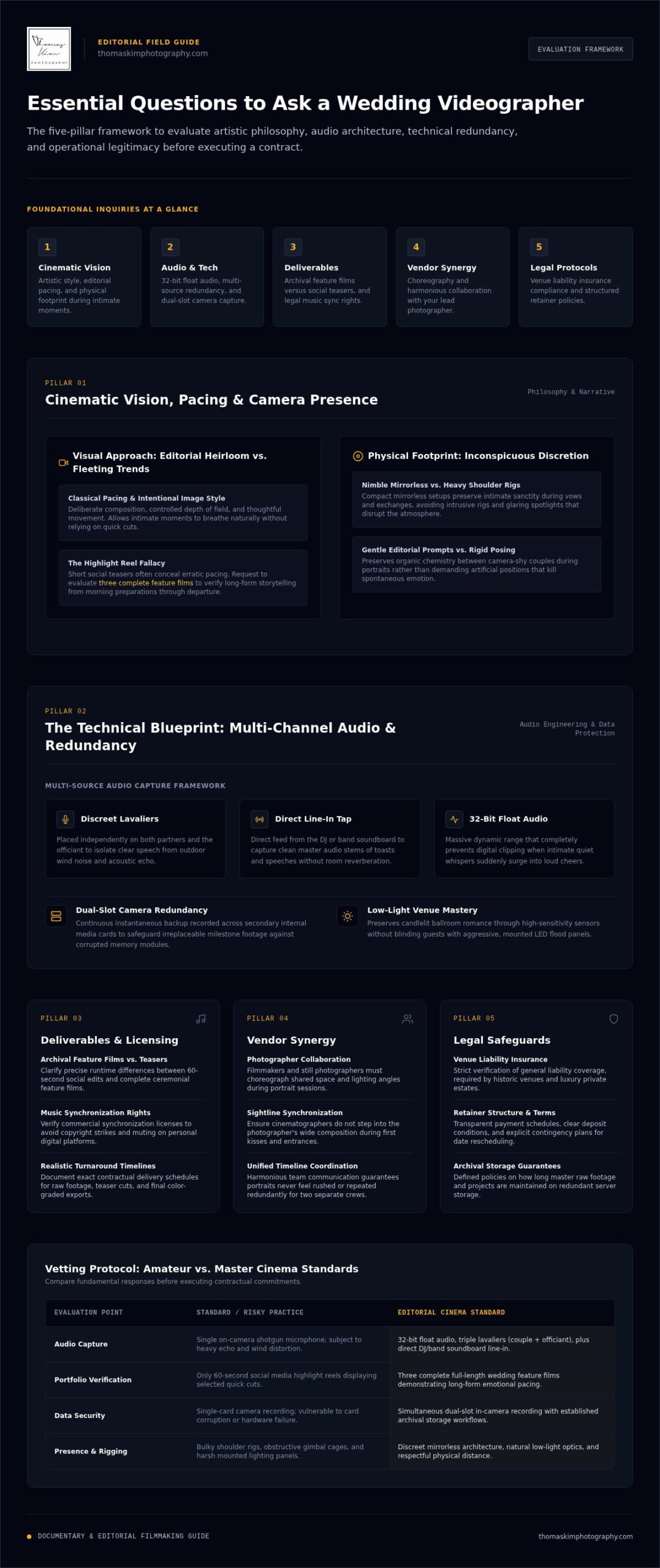
- How would you define your creative philosophy? Discover whether they shoot with deliberate composition, controlled depth of field, and thoughtful movement, or rely on handheld, journalistic instinct. Explore how an intentional image style guides visual rhythm.
- Can we review three complete wedding feature films? Highlight reels conceal erratic pacing and awkward pacing transitions. Viewing full films guarantees their long-form storytelling sustains emotional gravity from the morning preparations through the final departure.
- Does your editing prioritize timeless elegance or fleeting viral trends? Fast-paced quick cuts and heavy digital filters quickly date your film. Heirloom cinema relies on classical pacing that lets intimate scenes breathe.
Camera Presence: Inconspicuous Capture vs. Directed Posing
Discretion preserves reverence. Your wedding is an intimate milestone, not an intrusive Hollywood set. You must evaluate how the filmmakers interact with you and your guests throughout high-stakes moments. Will they command the room with heavy shoulder rigs and glaring spotlights, or will they melt seamlessly into the background? Clarifying these boundaries ensures your celebration flows without friction.
- What physical footprint do your filmmakers maintain during private moments? Inquire whether they operate nimble, mirrorless camera bodies or cumbersome gimbal stabilization rigs that disrupt sacred vow exchanges.
- How do you draw natural emotion from camera-shy couples? A refined artist offers gentle, editorial prompts during bride and groom portraits rather than demanding rigid poses, preserving organic chemistry while curating flawless cinematic frames.
Prioritizing these core questions to ask a wedding videographer establishes an immediate creative alignment. You ensure that your team honors the authentic atmosphere of your celebration while capturing it with absolute artistic command.
The Technical Blueprint: Inquiring About Audio Capture, Lighting, and Redundancy
Flawless visuals mean little if the spoken word fails. A beautifully graded 4K sequence cannot rescue distorted vows, muffled toasts, or wind noise tearing across an outdoor cliffside. When building your list of questions to ask a wedding videographer, technical precision deserves equal weight alongside artistic taste. You need certainty that your production team commands pristine audio architecture, subtle lighting, and ironclad data security.
Audio Engineering: Preserving Vows, Speeches, and Ambient Atmosphere
Mastering sound requires multi-source redundancy. Inquire whether your filmmaker records in 32-bit float audio, a recording standard providing immense dynamic range that prevents digital clipping when quiet whispers suddenly turn into joyous cheers. Ask if they place discreet lavalier microphones on both partners and the officiant, while simultaneously securing a direct line-in tap into the DJ or band soundboard. Capturing clean master audio stems directly at the source protects the spoken narrative from harsh room echo.
Lighting Protocols and Low-Light Venue Mastery
Atmosphere is delicate. Harsh, mounted LED panels destroy the romantic ambiance of a candlelit dinner or historic ballroom. Probe into their low-light philosophy:
- How do you preserve dim evening lighting without blinding our guests? A seasoned filmmaker relies on wide-aperture lenses and dual-native ISO camera sensors to harvest available candlelight before ever introducing off-camera, diffused accent lights.
- How do you manage high-contrast afternoon sun? Explore their approach to harsh golden hour transitions, ensuring rich dynamic range across both bright skies and deep shadow details.
Failsafe Systems: Equipment Backups and Data Redundancy
Unrepeatable milestones offer no second takes. Hardware failures happen, but true luxury studios build layered safeguards to prevent loss. Confirm that every primary camera writes continuously to dual card slots simultaneously, creating immediate on-body backups during the vows. Inquire about their post-event protocol: are drive transfers executed immediately on-site with checksum verification? As emphasized in U.S. Copyright Office guidance on media ownership and licensing, legal and archival safeguards begin the moment footage is captured. Verify how off-site cloud storage and physical archives protect your master assets for years to come.
When selecting your creative partners for luxury weddings, evaluating these technical systems guarantees your celebration is documented with absolute security and pristine acoustic depth.
Deliverables, Timelines, and Licensing: Unpacking the Fine Print
Ambiguity in a contract breeds disappointment. A luxury film suite encompasses far more than a single video file, requiring precision regarding timelines, asset variations, and intellectual property. When preparing the essential questions to ask a wedding videographer, ensure your expectations align precisely with what will be crafted during post-production.
Deconstructing the Film Suite: Teasers, Highlights, and Feature Cuts
Terminology varies wildly across boutique studios. What one filmmaker labels a “highlight film,” another might consider a brief social teaser. Require a clear inventory of assets before signing:
- Social Teaser: Typically a 60-second vertical or widescreen preview cut for immediate digital sharing, often delivered within 24 to 72 hours.
- Cinematic Highlight Film: A 5-to-10-minute editorial short film set to licensed music, weaving narrative audio, ceremony highlights, and reception toasts into a cohesive emotional arc.
- Documentary Feature Film: An extended 30-to-60-minute archival cut containing full-length ceremony readings, uninterrupted toasts, and the complete first dance.
- Raw Footage Access: Determine whether unedited, source camera clips are archived, delivered on an external hard drive, or retained exclusively by the studio.
- Aerial Drone Coverage: If aerial cinematography is planned, confirm the studio operates under current FAA Part 107 commercial drone regulations with active Remote ID compliance.
Music Licensing and Creative Revision Policies
Soundtrack selection defines emotional memory. However, commercial radio tracks cannot be legally embedded into wedding films without severe copyright infringement risks and platform mutes. Ask which professional licensing platforms the studio uses, such as Musicbed or Soundstripe, to legally source cinema-grade scores. Clarify whether you will collaborate on mood boards to establish tempo and instrumentation, or if the filmmaker selects the final music independently.
Turnaround times demand equal transparency. Editorial craftsmanship takes time. Standard turnaround for a bespoke cinematic edit typically spans 8 to 16 weeks, allowing meticulous color grading and audio mastering. Discover how their thorough photo editing and video grading workflow impacts production schedules. Clarify your contract’s revision policy: how many refinement rounds are included for color grading or pacing adjustments before incurring additional studio fees?
Thoroughly addressing these contractual questions to ask a wedding videographer safeguards both your investment and your peace of mind. Clear parameters protect the artistic integrity of your bespoke wedding suite.
Vendor Synergy: Questions on Photographer and Videographer Collaboration
Visual harmony requires unified orchestration. Your lead photographer and cinematographer compete for the exact same lighting windows, prime sightlines, and physical space during portraits. When independent vendors clash, the resulting friction drains your energy and fractures the visual tone of your wedding imagery. Ensuring seamless alignment across these creative teams is one of the most critical questions to ask a wedding videographer during your initial consultation.
Harmonizing Coverage: Shared Angles, Lighting, and Timeline Sync
A flawless wedding gallery and film require shared spatial awareness. An inexperienced filmmaker might ruin a priceless still photograph by wandering into the aisle during the first kiss, just as an assertive photographer might step directly across a moving gimbal track during the first dance. Clarify their operational choreography with targeted questions:
- How do you coordinate positioning during the ceremony processional and first look? Professional artists agree on dedicated camera zones beforehand, guaranteeing neither vendor blocks the other’s lens.
- Who directs couple portraits, and how is lighting shared? Both mediums require deliberate pacing. Inquire whether the videographer moves dynamically alongside the photographer or requests separate, dedicated timeline blocks that prolong your photo sessions.
- How do you synchronize schedules to eliminate timeline strain? An organized media team builds breathing room into luxury weddings, preventing the rushed, chaotic energy that leaves couples exhausted before their reception begins.
The Unified Studio Advantage: Why Cohesive Teams Excel
Cohesion creates timeless art. When you commission a boutique studio that directs both photography and film under one singular creative vision, logistical friction vanishes entirely. Shared color palettes, coordinated focal lengths, and mutual respect ensure that stills and motion complement rather than compete against one another.
A dedicated team shares unspoken communication, allowing seamless transitions from intimate getting-ready moments to grand ballroom entrances. If you desire a harmonious, stress-free media experience that preserves your milestone with effortless sophistication, connect with Thomas Kim Photography to secure cohesive documentation for your celebration.
Integrating these collaborative questions to ask a wedding videographer guarantees your day remains an unhurried, romantic experience rather than an exhausting, dual-crew production set.
Booking, Logistics, and Final Decisions: The Decision-Making Framework
A transformative film begins with operational discipline. Beyond artistic resonance and acoustic mastery, the final step before committing to an engagement involves strict business diligence. Reviewing these logistical and legal questions to ask a wedding videographer safeguards your investment, ensuring your chosen storyteller carries the professional credentials demanded by premiere venues.
Legal Safeguards: Insurance, Permits, and FAA Drone Regulations
Luxury private estates and historic properties maintain rigorous vendor requirements. Never assume compliance without documented verification:
- Can you provide a Certificate of Insurance (COI)? High-end venues routinely require proof of $1,000,000 to $2,000,000 in general commercial liability coverage naming the property as an additional insured.
- Are your drone operators FAA Part 107 certified? Commercial aerial cinematography requires active federal licensure and Remote ID compliance. Operating without these credentials exposes the venue and your timeline to federal grounding.
- Who secures commercial filming permits? Inquire how the studio handles local municipal and park filming permits across their designated service regions. Unpermitted filming risks immediate interruption on your wedding day.
Securing Your Date: Retainers, Contracts, and Next Steps
Contracts protect mutual devotion to craft. Inquire about payment schedules, which standardly involve an upfront non-refundable retainer upon signing, followed by the remaining balance closer to the wedding date. Clarify force majeure policies, illness contingencies, and overtime rates should reception toasts extend past schedule. Don’t overlook crew meal provisions and travel logistics, as clear expectations prevent unexpected charges later.
Above all, evaluate personal chemistry during your initial consultation. Your filmmaker shares your most vulnerable milestone moments. Their presence must bring stillness, confidence, and quiet grace to your inner circle, allowing you to remain entirely present.
When you are ready to entrust your milestone to an artist committed to enduring legacy, connect with Thomas Kim to discuss your artistic vision and preserve your story with cinematic permanence.
Preserving Your Legacy Through Intentional Cinema
Your wedding milestone deserves far more than a disconnected montage of fleeting moments. By presenting these essential questions to ask a wedding videographer, you safeguard your celebration against acoustic failure, vendor friction, and intrusive equipment. You ensure every whispered vow, candid glance, and joyous toast is preserved with reverence, technical excellence, and artistic permanence.
Cinema is an intimate act of trust. When your visual legacy is guided by a boutique fine art philosophy, photography and motion move in effortless harmony under one singular vision. Drawing upon years of narrative storytelling across iconic Southern California landscapes, our studio transforms unrepeatable memories into museum-grade art. Take the next step toward effortless elegance: Inquire About Your Date with Thomas Kim to craft a wedding film that endures for generations.
Frequently Asked Questions
How far in advance should we interview and book our wedding videographer?
Couples should interview and book their wedding videographer 9 to 18 months before their celebration date. Premier dates across Southern California and luxury Los Angeles estates book rapidly, with boutique studios accepting limited annual commissions to ensure bespoke craftsmanship. Posing this early among your questions to ask a wedding videographer secures your preferred team, allowing ample runway to align creative vision and establish timeline logistics.
What is the difference between a highlight reel and a documentary edit?
A highlight film is a concise 5 to 10-minute cinematic piece designed with artistic color grading, narrative audio pacing, and licensed music to capture the day’s emotional core. In contrast, a documentary edit delivers extended, chronological documentation. It provides complete, multi-camera recordings of the entire ceremony, uninterrupted reception toasts, and formal dances, preserving the full historical record of your milestone.
Why do professional wedding videographers require commercial music licensing?
Federal copyright laws prohibit embedding commercial radio tracks into video productions without expensive synchronization licenses. Professional filmmakers license tracks through curated music platforms like Musicbed to protect your film from being muted, flagged, or deleted on public sharing platforms. This adherence to legal standards guarantees that your cinematic wedding film remains accessible, beautifully scored, and permanently protected across digital channels.
Can our wedding videographer provide all the unedited raw footage?
Most professional studios can provide unedited raw footage upon request, often delivered on an external hard drive. However, understand that raw camera files consist of hundreds of uncolored, flat-profile clips and separate audio stems rather than a finished film. Including this topic in your questions to ask a wedding videographer ensures you understand hard drive storage logistics and delivery expectations before booking.
How do wedding videographers capture clear audio during windy outdoor ceremonies?
Professional filmmakers utilize broadcast-grade lavalier microphones fitted with acoustic wind protection like high-density furry windshields. In breezy outdoor environments, such as coastal Southern California bluffs or open canyons, they deploy 32-bit float recording hardware. This advanced dynamic range captures delicate whispers clearly while preventing distorted audio clipping from sudden gusts, preserving your vows with crystalline clarity.
Do wedding videographers need to attend the rehearsal dinner before the wedding?
Attendance at the rehearsal dinner is rarely necessary for technical staging unless your package includes event coverage for pre-wedding toasts. Experienced filmmakers coordinate venue logistics and sightlines directly with venue coordinators and planners in advance. If your ceremony features complex staging or unique cultural traditions, scheduling brief rehearsal coverage ensures every critical movement is mapped beforehand.
What happens if our wedding videographer falls ill on our wedding date?
Reputable boutique studios maintain emergency contingency plans backed by a network of master-level cinematographers. Should sudden illness arise, an experienced associate shooter operating matching camera gear and technical profiles steps in seamlessly. The primary studio director retains full control of the post-production, color grading, and creative editing, ensuring the final visual narrative meets the exact standard promised in your agreement.
Why should we consider hiring our photographer and videographer from the same studio?
Commissioning a single luxury studio for both photography and videography guarantees complete artistic and logistical synergy. A unified team shares complementary lighting approaches, synchronized schedules, and natural communication. They move in harmony during portraits and pivotal ceremony moments rather than competing for sightlines. This cohesion creates a relaxed atmosphere for couples and delivers a visually harmonized collection of stills and motion.